
The Clover Method
The Clover Method is a structured set of on-ground agricultural practices designed in-house, derived from different ‘Organic Philosophies’ like Microbial, Bio-dynamic, Vermi, Agnihotra, etc., and taken from farmers in the form of ITKs to improve soil health, reduce input costs, and increase farm productivity without dependence on external or chemical inputs. It combines scientific understanding with traditional knowledge, enabling farmers to adopt organic or regenerative farming in a way that is both practical and economically viable.
Built for scalability, the method is designed to work across geographies, farm sizes, and cropping systems. It prioritises simplicity, accessibility, and measurable outcomes, making it particularly effective for large-scale government and development programs.
Core Practices
Instead of abstract principles, the Clover Method is driven by a set of clearly defined, field-level practices. Some of them are being shared here.
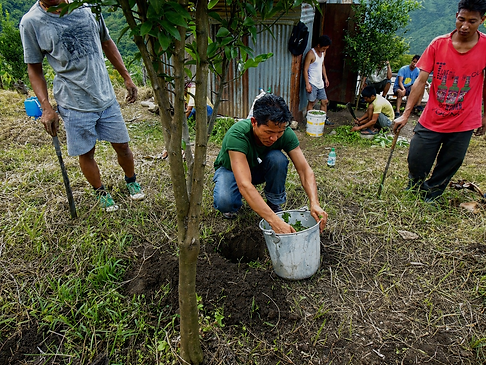
Energy Pillars
A targeted nutrient delivery system where organic biomass is placed around the root zone to directly feed plants, improve root strength, enhance resistance to stress and reduce fruit dropping amongst other benefits.
Clover Mulching
A low-cost mulching technique using locally available biomass to retain moisture, suppress weeds, and enrich soil biology, sprayed with unique organic input to significantly improve soil fertility, reduce irrigation needs and need for weeding.


Liquid Mulching
A specialised application for paddy systems that creates a natural barrier to weed growth, reducing labour substantially and improving productivity in early crop stages.
Rapid Composting
Different ways to accelerate compost production using biological inputs, enabling farmers to generate nutrient-rich compost within a short cycle. The composting process ranges from agriculture level to industrial level covering all sorts of organic biomass for making quality compost.


Vertical Farming Applications
Optimised use of space through vertical growing systems, particularly useful in high-density or resource-constrained environments. The model is DIY (Do it Yourself) using locally available materials.
Why It Works
Cost-Effective by Design
The method relies on locally available biomass and natural processes, reducing dependence on external inputs and lowering overall cultivation costs.
Simple to Adopt
Techniques are easy to understand and implement, making them accessible to farmers with varying levels of experience.
Ecologically Regenerative
By improving soil structure, microbial activity, and biodiversity, the method strengthens the natural foundation of farming systems.
Climate-Resilient
Healthier soils and stronger root systems improve resistance to drought, pests, and climatic variability.
Built for Scale
The method has been successfully deployed across large farmer networks, supported by structured training and community-led knowledge sharing.
Impact At Scale
The Clover Method is not just a theoretical model; it is a proven system that has been implemented across diverse regions, delivering tangible improvements in productivity, cost efficiency, and ecological outcomes.
65,000+
49,000+
1,300+
200+
Farmers Trained
Hectares Covered
Trainings Conducted
FPOs Engaged
Where It Fits
The Clover Method is integrated across all our projects, supporting:
-
Organic transition programs
-
Integrated farming systems
-
Agroforestry and restoration initiatives
-
Government and CSR-led rural development projects